
Klaipėda Ferry Port: Terminals, Getting There and Onward Travel
Klaipėda has several ferry areas, and the right one depends on whether you are arriving internationally or taking the local ferry to Smiltynė. The city ferry has an Old Ferry Terminal and a New Ferry Terminal, with different rules for carrying vehicles. Check addresses, departures and check-in separately for your specific journey. This overview will help you avoid confusing the terminals and plan your onward journey into the city or to the Curonian Spit.
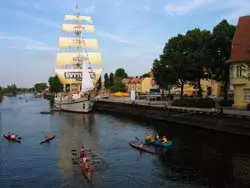 Das Segelschiff liegt an einer innerstädtischen Kaianlage in Klaipėda; kleine Boote fahren über das Wasser.
Quick facts
- Local connection: The Old and New Ferry Terminals connect mainland Klaipėda with Smiltynė on the Curonian Spit.
- Old Ferry Terminal: It is near the city centre and carries pedestrians, bicycles and pets, but no motor vehicles.
- Address, Old Ferry Terminal: Šiaurinis Ragas, E. Galvanausko bul. 1.
- New Ferry Terminal: The local vehicle ferry departs from Nemuno g. 8 and carries cars and buses, as well as pedestrians and cyclists.
- International arrivals: DFDS lists the Central Klaipėda Terminal (CKT), at Baltijos pr. 40, for passenger services; check the details in your booking.
- Direct to the museum: Special ferries run from the Old Ferry Terminal directly to the Lithuanian Sea Museum and Dolphinarium.
- Timetable: Departure intervals and seasonal services may vary; check the latest information on the day of travel.
First, distinguish between the local ferry and an international crossing
In Klaipėda, the term “ferry port” can refer to different places. Local ferries to Smiltynė cross the Curonian Lagoon and form part of the local transport link between the city and the spit. International passenger ferries, by contrast, use a separate terminal area. So don’t rely on a generic map pin labelled “Klaipėda port”: check your booking to see whether you need to go to the Old or New local Ferry Terminal or to the international passenger terminal.
Your approach also depends on how you plan to continue your journey. If you’re on foot or travelling by bicycle, the Old Ferry Terminal in the city centre is often the right connection to Smiltynė. If you’re taking a car to the spit, you’ll need the New Ferry Terminal. For an international arrival, follow the terminal details provided by the ferry operator—not the address of the local car ferry.
Old Ferry Terminal: on foot, by bicycle or with a pet
The Old Ferry Terminal is in the centre, near where the Danė flows into the Curonian Lagoon. The official tourism information gives its address as Šiaurinis Ragas, E. Galvanausko bul. 1. Local ferries from here carry pedestrians, bicycles and pets; cars and other motor vehicles are not carried at this terminal. If you’re travelling by car, don’t simply follow the address in the Old Town and expect to board there.
Special services also run from the old landing to the Lithuanian Sea Museum and Dolphinarium. Check separately whether this service operates on the day you visit: it does not automatically replace the regular crossing to Smiltynė and may have its own departure times or conditions. For a walk around the city before or after your crossing, see the article about Klaipėda as a port city; for specific attractions in the centre, see things to see in Klaipėda.
New Ferry Terminal: if you’re taking a vehicle
The New local Ferry Terminal is at Nemuno Street 8, farther south than the old landing. According to the tourism information, ferries here carry cars and buses, as well as pedestrians and cyclists. This is the local connection to check if you want to take a vehicle to Smiltynė. However, the name “New Ferry Terminal” does not automatically mean it is the terminal for an international crossing.
Before setting off, check the departure point, vehicle category, ticket requirements and current waiting conditions. Special rules may apply to bicycles, trailers or larger vehicles; don’t assume that every ferry treats all vehicle types the same way. The local information explicitly distinguishes between the Old and New Ferry Terminals. You can also consult this general overview of ferry connections to Lithuania, but the operator’s specific instructions for your journey take precedence.
International passenger ferry: check your booking and terminal
If you’re travelling to Klaipėda on an international passenger ferry, use the terminal listed in your booking confirmation for that specific route. DFDS lists the Central Klaipėda Terminal at Baltijos pr. 40. As check-in, access and procedures may vary by route and departure, confirm the address against your travel documents before setting off. The official DFDS terminal information for Klaipėda is a good place to start; for your specific trip, the details in your booking are what matter.
Allow extra time for getting to the terminal, possible checks and check-in. If you plan to continue by train, coach or taxi after arriving, check the connection between the terminal, your accommodation and your next mode of transport in advance. If you arrive late, staying overnight in the city can make the transition easier. To find a suitable base, compare accommodation in Klaipėda and check its location and how to get back to the station or city centre.
From Smiltynė onward to the spit and coast
The crossing to Smiltynė is only the first leg if you’re continuing towards Nida or Juodkrantė. Factor in travel across the spit, your next connection and the return journey, rather than planning only for the duration of the ferry crossing. The Curonian Lagoon lies between the mainland and the spit; the page about the Curonian Lagoon will help you distinguish this body of water from the open Baltic Sea.
For a longer stay, you can choose accommodation either in the port city or on the spit. The overviews of Neringa and accommodation in Neringa can help you plan stays in different places. If you’re looking for a beach, promenade or lively centre rather than dunes and nature, the guide to a Baltic holiday in Lithuania compares different coastal destinations. This will help you decide whether Klaipėda should be your starting point, a stopover or your main base.
Before departure: a quick checklist
Open your booking and note the exact terminal address, required arrival time and conditions for vehicles, luggage or pets. Then check whether you have booked a local crossing to Smiltynė or an international passage. Match the terminal name to the correct address and check the timetable again on the day. Screenshots or outdated search results should not replace the operator’s latest information.
If you’re travelling by car, decide before setting off whether you want to take the vehicle to the spit or leave it in Klaipėda. For the latter, the pedestrian and bicycle services may be enough; for the former, you’ll need the vehicle ferry at the New local Ferry Terminal. Allow time for getting around and making connections on both sides of the crossing. The right accommodation can make for a more relaxed overnight stay after you arrive or before you continue your journey.
FAQ
Which ferry terminal should I use to get from Klaipėda to Smiltynė?
There are two terminals for the local crossing: the Old and New Ferry Terminals. Which one you need depends mainly on whether you’re travelling on foot, by bicycle or in a motor vehicle.
Can I take my car on the ferry from the Old Ferry Terminal?
No. According to the local tourism information, the Old Ferry Terminal carries pedestrians, bicycles and pets, but no motor vehicles. For a vehicle crossing, check the New local Ferry Terminal on Nemuno Street.
Is the New Ferry Terminal also the international DFDS terminal?
No. The New Ferry Terminal at Nemuno g. 8 serves the local route to Smiltynė. For an international journey, use the terminal specified for your route in your booking; DFDS lists a separate Klaipėda terminal for this purpose.
Where is the international passenger terminal?
DFDS lists the Central Klaipėda Terminal (CKT) at Baltijos pr. 40. Check the address and check-in details in your current travel documents before each departure, as the specific route matters.
How do I get from Smiltynė to Nida or Juodkrantė?
After the crossing, you’ll need to plan your onward journey on the spit and your return trip as well. Check connections and times for your travel date, and consider staying overnight in Neringa if you want to visit several places.
