
Discover Karvys: Manor Estate and Church History
Accommodation in Karvys
Karvys can be explored through three tangible traces: the fragments of the Karvio manor estate, the history of the church, and the life story of geologist Antanas Karolis Giedraitis. The stories range from surviving architectural features to former places of residence in the nearby area. Keeping their locations and time periods distinct makes the town’s history especially vivid.
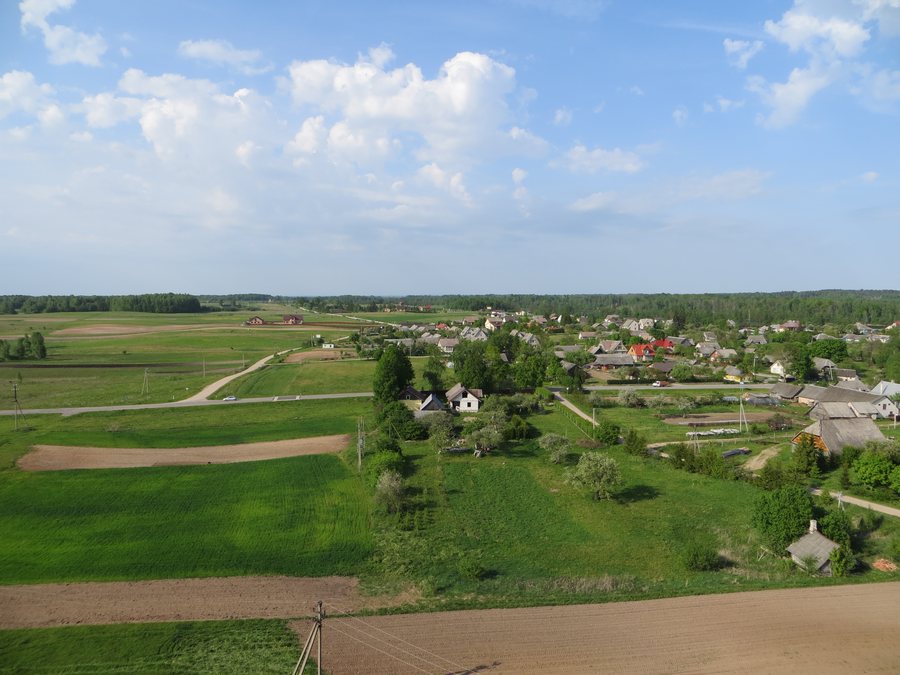
Key facts
- The fragments of the Karvio manor estate near Karvio ežeras in Karvys have been considered local cultural heritage since 1992.
- The neo-Gothic, two-towered Karvio Church of St. Joseph was completed in 1864 and is still standing today.
- The village’s first wooden church was built between 1779 and 1790, burned down in 1861 after being struck by lightning, and was later rebuilt.
- A 2023 heritage conservation article describes a small wooden storehouse with remnants of an earlier shingle roof beneath the slate roof.
- Antanas Karolis Giedraitis (1848–1909), born at the Karvio manor estate near Vilnius, was Lithuania’s first professional geologist and a pioneer of Quaternary research and geological mapping.
- From the age of three, Giedraitis lived with his parents at the Antanavas farmstead, a former manor outfarm in the nearby area.
Manor estate traces near Karvio ežeras
The fragments of the Karvio manor estate are located near Karvio ežeras in Karvys and have been considered local cultural heritage since 1992. A 2023 heritage conservation article describes a small wooden storehouse on the grounds that has survived; remnants of an earlier shingle roof are visible beneath its slate roof. The same article reports that one end of the second former servants’ house has retained its original appearance from the manor era.
The architectural features offer different clues to the estate’s history: at the storehouse, remnants of the older roofing are set against the slate roof, while part of the former appearance has survived on the servants’ house. This makes the town’s history tangible through specific architectural forms. For those interested in cultural history, this comparison is particularly illuminating: a roofing detail and a preserved part of a building each tell a different story about the estate’s architectural past.
Church history across several centuries
The first wooden church in the village of Karvys was built between 1779 and 1790. In 1861, it burned down in a fire caused by lightning. A few years later, it was rebuilt with the support of the faithful and the Giedraitis family. Its history thus includes both the early wooden structure and its reconstruction after the fire.
The neo-Gothic, two-towered Karvio Church of St. Joseph was completed in 1864 and is still standing today. The dates make the sequence clear: the construction of the first church was followed by the fire and reconstruction, before the completion of the 1864 church provided another point of reference in time. Together, these details offer a tangible way to understand the town’s building history without conflating different periods.
Antanas Karolis Giedraitis and Antanavas
Antanas Karolis Giedraitis (1848–1909) was born at the Karvio manor estate near Vilnius. He was Lithuania’s first professional geologist and is considered a pioneer of Quaternary research and geological mapping. His life story connects local history with the history of science: accounts of his work cover both research into the Quaternary period and the mapping of geological areas.
From the age of three, Giedraitis lived with his parents at the Antanavas farmstead, a former manor outfarm in the area near Karvys. The Karvio manor estate is identified as his birthplace; Antanavas was where he later lived as a child. Distinguishing between his birthplace and his former childhood home makes these stages of his life easier to understand, while also noting that the Antanavas farmstead is not in the village itself.
The manor estate, church, and biography offer complementary ways to explore Karvys: surviving architectural details, a history of construction, fire, and rebuilding, and Giedraitis’ scientific work and early years in the surrounding area.
Discover more destinations: Madžiūnai, Bezdonys, Avižieniai, Kiemeliai, Švenčionys, Strėva, Glitiškės, Aukštadvaris.
For the main travel overview: Vilnius District.

