
Discover Plungė: Park, Palace and City History
Accommodation in Plungė
Key facts
Plungė brings together the landscape of a former manor park with churches, monuments and a rich cultural history. When planning your trip, you might consider focusing on the park route, the palace and its traditions, or the city's buildings. These interests also provide a practical starting point for looking for a hotel in Plungė.
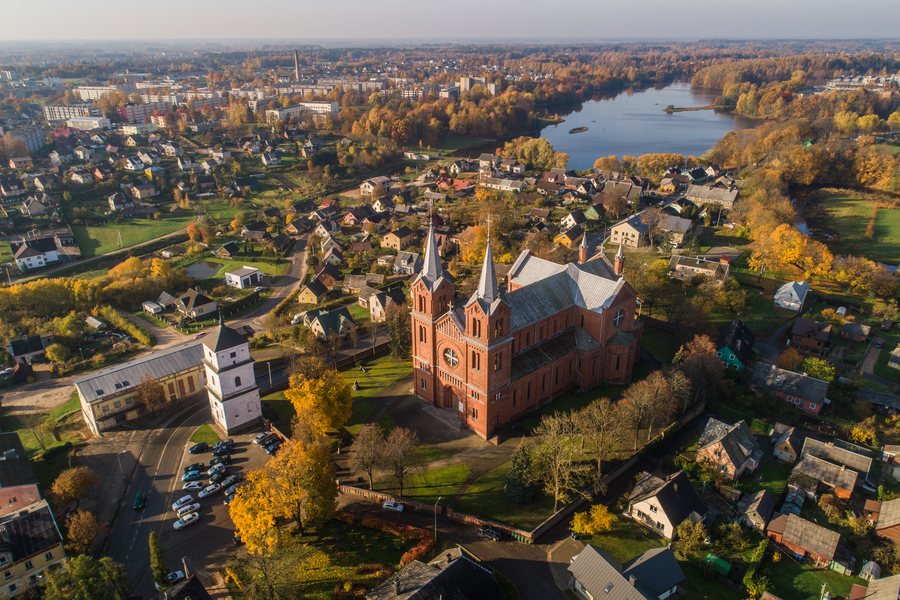 Plungė St John the Baptist church building complex and Lourdes replica with a sculpture of the Holy Virgin Mary 34-P
Photo: Žemaitijos kelias via Source, CC BY-SA 4.0
Plungė St John the Baptist church building complex and Lourdes replica with a sculpture of the Holy Virgin Mary 34-P
Photo: Žemaitijos kelias via Source, CC BY-SA 4.0
- Seven cascading ponds shape the park of Plungė Manor; stone bridges or sluices connect them, and the Babrungas flows through the park.
- The visitor route through the park begins at the main entrance, near the Plungė District Tourism Information Centre.
- From the route, you can see ponds, old trees and shrubs, as well as the Neo-Renaissance palace visible among the trees.
- The Perkūnas Oak stands in the central part of the park near Oginskis Palace and has been a natural monument since 1960.
- The clock tower is twelve metres high, has a clock with only one hand, and a bell that chimes hourly.
- The Žemaičiai Art Museum is housed in the palace of Mykolas Oginskis and preserves the manor's traditions.
- The Church of St John the Baptist and its bell tower tell the story of several building phases in the 19th and 20th centuries.
Parkland around Oginskis Palace
You can explore Plungė Manor Park through its ponds and visitor route. The seven cascading ponds were created on the orders of Duke M. Oginskis; stone bridges or sluices connect them. The Babrungas River flows through the park. Along the route, these water features are joined by views of old trees and shrubs. The Neo-Renaissance palace can be seen through the branches.
A notable spot in the central part of the park is the Perkūnas Oak, near Oginskis Palace. It was designated a natural monument in 1960. If you enjoy considering landscape and architectural history together, the park offers both: ponds shaped by people and views of the palace. The visitor route starts at the main entrance, near the Tourism Information Centre, providing a clear starting point for exploring this area.
Clock tower and church architecture
Plungė's red-brick clock tower is twelve metres high. Its clock has only one hand, and a bell chimes hourly. The tower is considered the city's oldest red-brick building; its design is reminiscent of a small version of the Palazzo Vecchio in Florence. After restoration and reconstruction work in 2012, the Plungė Clock Tower Library moved into the castle.
The buildings of the Church of St John the Baptist are considered the main attraction of the Old Town. The church is Neo-Romanesque, has a Latin-cross floor plan and two towers. Its present stone structure was built between 1902 and 1933 to a design by engineer Steponas Stulginskis, based on and revised from Karl Strandman's original design. The bell tower is an integral part of the church complex; Count P. Zubov had it built in 1850.
Museum, religious heritage and notable figures
The Žemaičiai Art Museum is housed in the palace of Mykolas Oginskis, where it preserves and fosters the manor's traditions. Guided tours in English or Russian are available for groups of no more than 25 people. This can help you decide whether to focus your plans on the palace as a place of manor tradition or primarily on the parkland.
M. K. Čiurlionis's story is also connected with Plungė. From 1889 to 1892, he studied at the orchestra school of M. M. Oginskis's manor and also played the flute in the Oginskis Orchestra. In 1909, M. K. Čiurlionis and Sof. Čiurlionienė-Kymantaitė lived in the old rectory. A monument to Čiurlionis stands in the park beside the palace, symbolising the connection between him and Mykolas Oginskis.
Religious heritage includes the restored Lourdes Grotto, with a copy of the statue of the Virgin Mary. It was solemnly consecrated on 20 October 1990. The old cemetery is also home to the stone Catholic Chapel of St John the Baptist, also known as the All Saints Chapel or Zubov Chapel. It was built in 1858 in the Romantic Classical style. The Freedom Monument adds to the city's history of remembrance: erected in 1928 to commemorate a decade of Lithuanian independence, it was removed after the Second World War and rebuilt in 1992.
Tailor your stay to your interests
The sights offer different points of interest: the park centres on water features, trees and views of the palace; the Old Town offers striking church architecture, while the museum and monuments introduce Plungė's cultural and historical themes. This lets you plan around the experiences you actually want, rather than combining different cultural sites into a single itinerary item.
More places for trip planning: Gečaičiai, Rapaliai, Telšiai, Varniai, Luokės Eldership, Mažeikiai, Plateliai, Ubiškė.
For the broader travel overview: Telšiai District.

