
Preila between the lagoon and the dunes
Accommodation in Preila
Preila at a glance
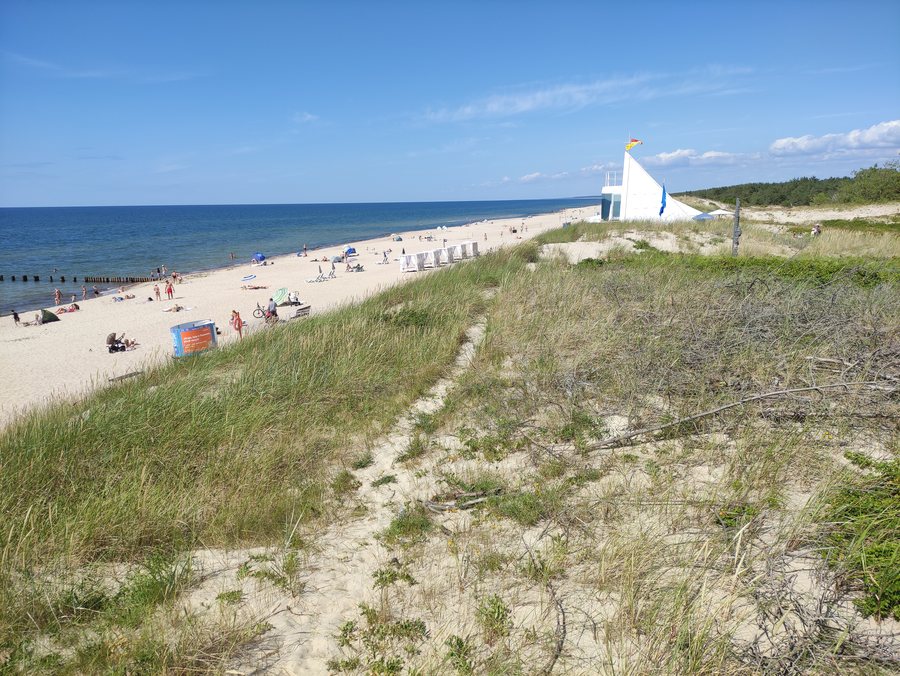
Preilos kopa is a useful landmark for anyone who wants to explore Preila on foot: you can climb the dune at the southern edge of the settlement. From there, the view stretches across the Baltic Sea, the shore of the Curonian Lagoon, Preilos ragas and the bay. With a little luck, you may also see the Horn of Ventė on the opposite side of the lagoon. Far to the south, Grobšto ragas, which belongs to Russia’s Kaliningrad Region, is sometimes visible.
- Preila was founded in 1843, when residents of Nagliai, which had been buried by sand, moved here via Purvynė.
- Preilos kopa lies at the southern edge of the settlement; a footpath begins there and follows the Curonian Lagoon to Nida.
- From the 53-metre-high dune, you may be able to see the Horn of Ventė, among other sights; this view is possible, but not guaranteed.
- The Curonian Loop long-distance cycle route runs through Preila.
- A branch of the V. Miliūnas Library is housed in the former school building and provides information about local attractions.
- Preila is known for smoked fish, including bream seasoned with smoke and herbs.
Dune scenery and far-reaching views
The ridge around Preila is almost entirely covered with pine forest. Mountain pines grow along the crests, while the slopes are mostly planted with Baltic pines. The dune therefore combines open views with wooded slopes. If you are interested in the names and stories of the landscape: several artists painted on Preilos kopa during the Soviet era. This is why Menininkų kopa, meaning “Artists’ Dune” in English, also became established among local residents.
Village history at the school and cemetery
Preila’s history is marked by the movement of its settlements. The sand forced the residents of Nagliai to leave their former home. They moved to Preila via Purvynė, and the settlement was founded in 1843. Another chapter in the school’s history followed in 1849: a school was moved from Naujieji Nagliai to Preila, where children from Pervalka also attended. After the former school building was destroyed by fire, a new brick school was built in 1907. It still stands today.
The old ethnographic cemetery also tells the story of the local heritage. It lies on the other side of the village’s only street, surrounded by forest. A walk here brings you into contact with different facets of Preila’s history: the residents’ resettlement, the development of the school and a cemetery in its wooded setting. These places represent specific chapters in village life, without requiring you to work through a long list of attractions.
Getting around on foot or by bike
For a walk, Preilos kopa is both a starting point and a scenic destination: a footpath leads from there along the Curonian Lagoon to Nida. The Curonian Loop long-distance cycle route is another way to include Preila in a bike tour; its route passes through the settlement. These are two different routes with different destinations. Check the current conditions for the cycle route before setting out. When planning a trip, you can choose between the described footpath towards Nida and the cycle route through Preila.
Library and local cuisine
A branch of the V. Miliūnas Library is located in the former school building. Visitors can get information about local attractions there; check whether the branch and information service are available before your visit. The library also offers free exhibitions and workshop spaces. If you would like to use these facilities, check which ones are currently available before visiting.
Preila is also known for smoked fish. You can buy smoked bream seasoned with smoke and herbs from a fisherman. A shelter set up by the Curonian Lagoon is recommended as a place to eat. If you would like to try the fish, ask in advance whether it is currently available. Along with the path by the dune, historic sites and insights into the library, this gives you several specific ways to plan your stay in Preila around your interests.
For the broader travel overview: Neringa Municipality.

